

We are not always
the same color.
For years, I painted almost exclusively with blue.
Not because I had decided it would become my color.
I simply kept looking for it.
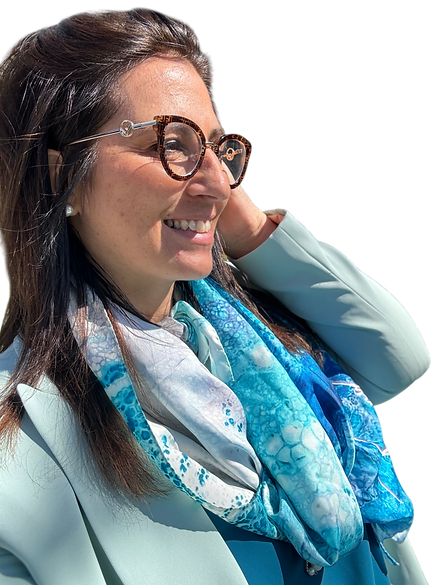

I have studied Jung extensively, and his ideas have influenced the way I view colors, images, and symbols.
I believe certain things can reach us before we are even able to explain them rationally.
The same applies to color.
We are not always the same color. Sometimes, we seek out exactly what we need at that moment.
For a long time, that color was blue for me.
And along with blue, water kept recurring: its depth, what moves beneath the surface—something that changes shape without ceasing to be itself.
I don't think it’s a coincidence. Yet, it isn't just what water conceals in its depths that interests me.
It is what water *does*.
Today, other colors are finding their way into my work.
Some are decidedly bold. That doesn't mean blue is no longer a part of me.
Perhaps I simply need to look elsewhere, too.
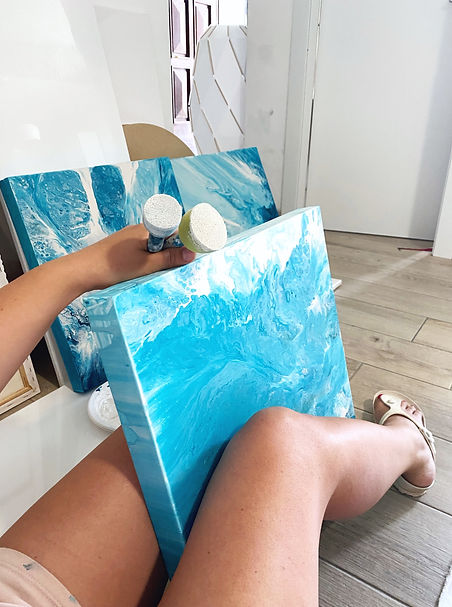
THE MOVEMENT.
There is something that recurs in my work even more often than blue,
than water or the circle.
The movement.
I realize that I find it hard to leave anything completely still.
The color flows, opens up, meets another color, and changes direction.
The material creates waves, ridges, and interruptions.
Even when I work on a static surface,
I look for something that conveys the feeling that
what we are looking at is still unfolding.
Perhaps that is also why water recurs so often in my work.
I am certainly interested in the depth of water—what lies beneath the surface, unseen at first glance.
But I’m just as interested in the fact that she never really stands still.
It can be almost motionless and yet keep moving.
It can change shape, reflect its surroundings, leave a trace, and—an instant later—already be different.
It is something I seek out even when I am not painting water.
I am not interested in representing movement.
I am interested in making it happen.
That is why I work with fluid color, but also with texture.
I create waves, reliefs, openings, and directions for the eye to follow.
I like it when a work does not reveal itself all at once.
When it looks like one thing from a distance, but something else happens as you get closer. When the light changes something.
When the gaze starts from a point and, almost without realizing it, is drawn elsewhere.
A work of art is motionless.
What happens while we watch it—no.

.png)

THE CIRCLE.
It isn't just a form.
But the aesthetics were merely the tip of the iceberg.
There was something about that form that drew me in far more deeply—even before I could explain why.
I have studied Jung extensively, and I have always been fascinated by the meaning he attributed to the circle: a form linked to wholeness, to the search for the center, and to the possibility of holding together different parts of ourselves.
And I believe that is precisely what I continue to seek within it.
My work often stems from the meeting of seemingly opposing forces:
Control and the unexpected, order and chaos, depth and lightness, what we know about ourselves and what we cannot yet name.
The circle is the place where I manage to bring them together.
Within a perfect form, I can let the color move, let the material change, let something escape what I had imagined.
Not to eliminate the chaos.
To give it a space.

For a long time, the circle was also this: a protected place. A space where the noise could pause long enough to let me look at what was inside, without necessarily having to understand, correct, or judge it.
I do not paint only circles, and I do not want a shape to become a boundary.
I work on canvas, wood, and Plexiglass; I use color, gesso, cold-process ceramics, and raw material.
Today, I am also increasingly interested in transparency, light,
and the possibility of the work occupying space.
The form may change.
What I seek, does not.